A Brief History of the DDR’s Flag Carrier
Welcome to the historical profile of Interflug (Interflug Gesellschaft für internationalen Flugverkehr m.b.H.), the state-owned national airline of the German Democratic Republic (GDR). Operating from 1958 until its liquidation in 1991, Interflug served as East Germany’s primary bridge to the world, combining commercial aviation with Cold War geopolitics.
Based at Berlin-Schönefeld Airport, the airline was far more than a commercial carrier. It managed all civil aviation in East Germany, including agricultural spraying, airport infrastructure, air traffic control, and close logistical operations with the military’s elite government transport wing, TG-44.

An Ilysushin 11-14 seen at SXF in 1961, behind the Aircraft construction of the new terminal can be seen.
THE LUFTHANSA LEGAL BATTLE (1954–1963)
The origin of Interflug is rooted in intense Cold War legal maneuvering. Following the division of Germany, both East and West Germany attempted to claim the legacy, name, and branding of the pre-war national carrier, Deutsche Lufthansa.
- 1954: West Germany registers “Deutsche Lufthansa AG.”
- 1955: East Germany creates its own “Deutsche Lufthansa” to serve as its state carrier.
- The Dispute: A lengthy international legal battle ensues over the rights to the Lufthansa trademark. West Germany successfully blocks the East German entity from joining international aviation bodies.
- 1958: Anticipating a legal defeat, the East German government creates “Interflug” as a secondary charter airline.
- 1963: The East German Lufthansa is officially liquidated, and Interflug is elevated to become the sole, official state airline of the GDR.
THE SOVIET FLEET AND OPERATIONS
As a key member of the Comecon (Council for Mutual Economic Assistance), Interflug relied almost exclusively on Soviet-designed aircraft. The airline’s fleet mirrored the technological developments of the Eastern Bloc.
- The Propeller Era: Early long-range and regional flights relied on the Ilyushin Il-14 and the rugged turboprop Ilyushin Il-18.
- The Jet Age: The carrier modernized with the short-range Tupolev Tu-134 and the long-range, four-engine Ilyushin Il-62, which became the flagship of the Interflug fleet.
- Route Network: Interflug primarily served the Soviet Union and other Comecon states. However, it carved out a profitable niche by offering flights to non-aligned nations in Africa, the Middle East, and Southeast Asia.
- The Western Lifeline: Crucially, Interflug operated flights to Western Europe, including destinations like Vienna, Brussels, and Amsterdam. Berlin-Schönefeld Airport became a major transit hub for West Berliners looking for cheap flights to Southern Europe and the Middle East, bypasssing Western airport taxes.
THE STASI AND THE German inner border
Because Interflug operated across the Iron Curtain, it was heavily targeted for infiltration by the Ministry for State Security (the Stasi). Traveling abroad offered a rare opportunity for East German citizens to defect, turning every flight into a high-security operation.
- Personnel Vetting: Pilots, flight attendants, and ground technicians underwent extensive surveillance. Anyone with family in West Germany or suspected political disloyalty was stripped of international flight clearance.
- Inoffizielle Mitarbeiter (IMs): The Stasi maintained a dense network of unofficial informants embedded within flight crews. Flight attendants routinely spied on coworkers and passengers alike.
- The Flight Crew “Hostage” Policy: On flights to Western destinations, the Stasi ensured that crew members with spouses or young children back home were paired together, using their families as leverage to prevent pilot defections.
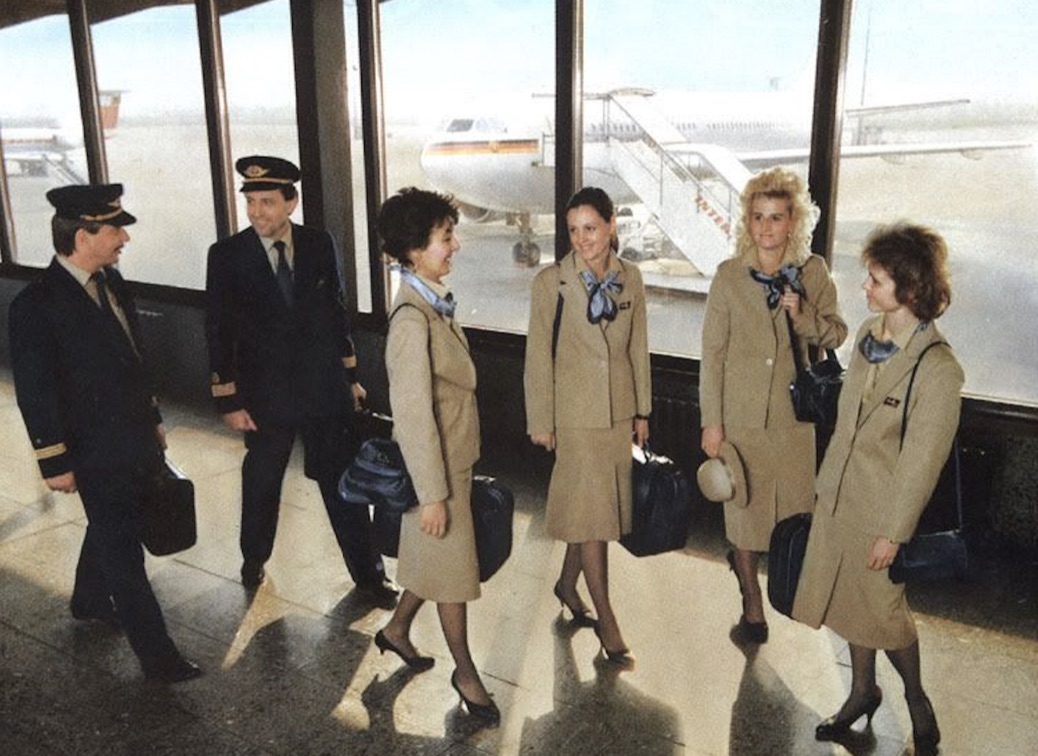
A Interflug crew
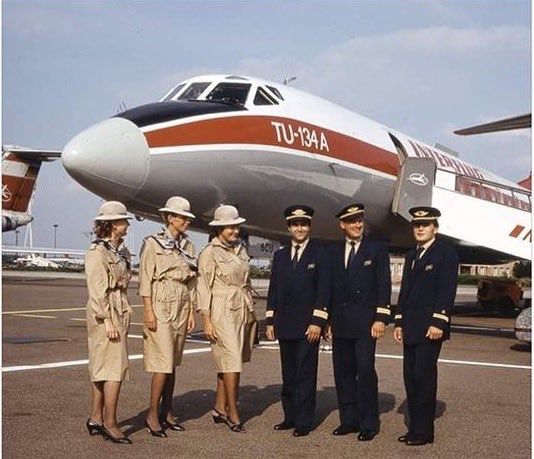
Interflug crew on a stand at SXF
THE WESTERN SURPRISE: THE AIRBUS ACQUISITION (1988)
By the late 1980s, Interflug faced a severe economic crisis. Its aging Soviet fleet, particularly the Ilyushin Il-62M, consumed too much fuel and violated increasingly strict Western noise pollution regulations. Denied newer Soviet aircraft due to production delays in the USSR, the GDR made a shocking geopolitical pivot.
- 1988: In a highly unusual deal financed by West German banks, Interflug purchased three state-of-the-art Airbus A310 widebody jets from Western Europe.
- The Impact: The Airbus aircraft drastically reduced operating costs and allowed Interflug to market modern, competitive premium services to international travelers, momentarily breathing new life into the struggling airline.

The Airbus A-310 was the last type of aircraft in Interflug’s fleet. Two were operated and continued in service with the German Air Force after reunification in 1990
REUNIFICATION AND LIQUIDATION (1990–1991)
The fall of the Berlin Wall in November 1989 spelled the end for Interflug. Stripped of state subsidies and thrust overnight into a highly competitive capitalist market, the airline could not survive.
- October 1990: With German reunification, the airline was placed under the control of the Treuhandanstalt, the federal agency tasked with privatizing former East German state enterprises.
- The Failed Buyout: Interflug executives desperately sought a Western partner. British Airways, Lufthansa, and various investors expressed brief interest but ultimately backed out due to Interflug’s mounting debts and obsolete infrastructure.
- April 1991: Unable to find a buyer or partner, the Treuhandanstalt ordered the complete liquidation of the airline.
- The Final Flight: On April 30, 1991, an Interflug Tu-134 flew the final commercial route from Dresden to Berlin-Schönefeld, bringing a definitive end to East Germany’s aviation history.
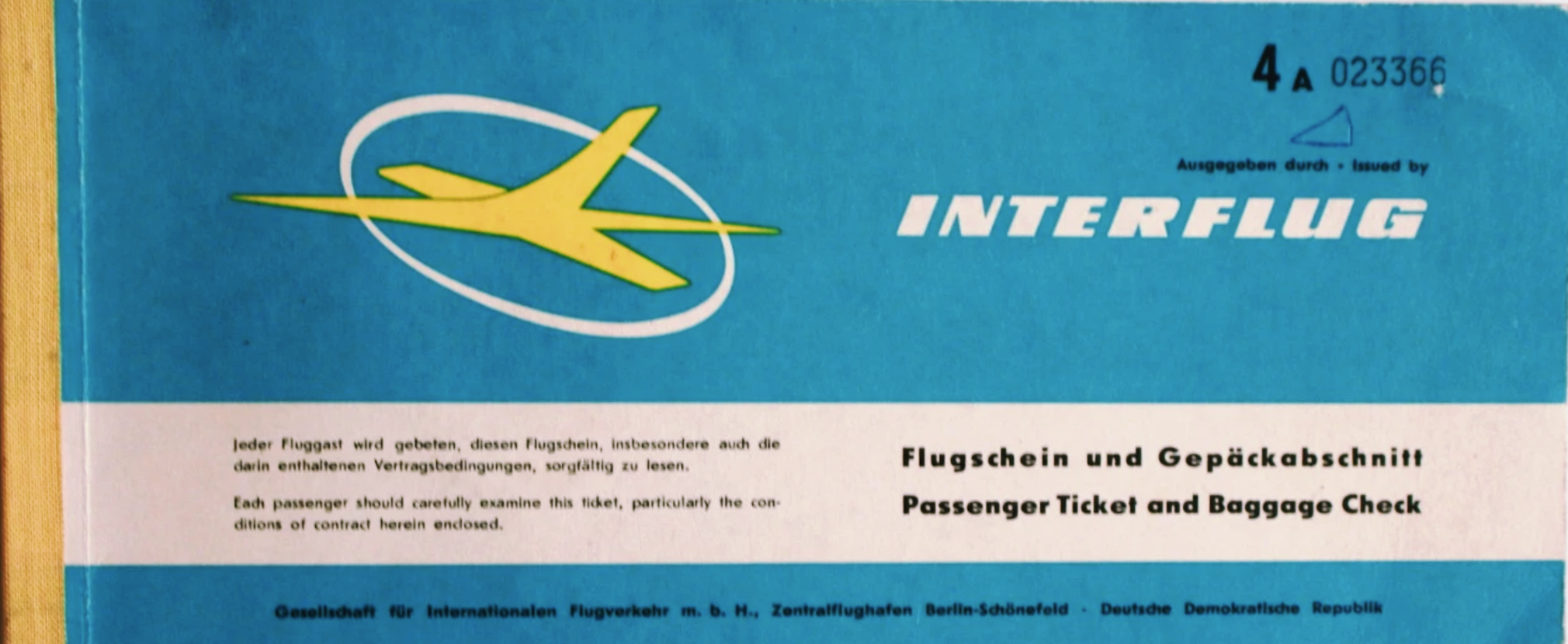
A Interflug ticket issued in 1964

A ticket issued to me in 1985 for a flight from SXF to Amsterdam