Welcome to the historical profile of Transportfliegergeschwader 44 (TG-44). Stationed at the highly secure Marxwalde (Neuhardenberg) airbase, this elite military formation served as the DDR’s VIP and special missions squadron from 1965 until German reunification in 1990.
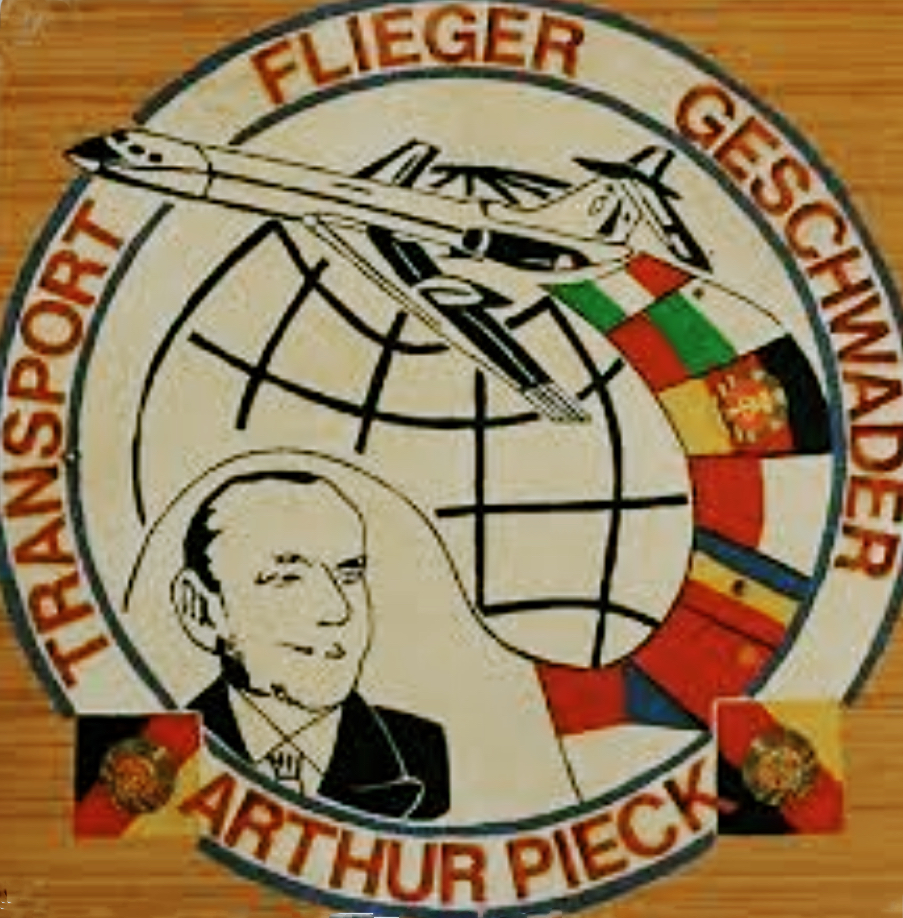
Operating under the direct command of the Nationale Volksarmee and the MFS, TG-44 was responsible for the safe transport of the GDR’s highest-ranking officials—including Head of State Erich Honecker—alongside foreign dignitaries and diplomatic delegations.
The Interflug deception
To project a peaceful civilian image during international state visits, TG-44 operated under a shroud of operational secrecy. While the pilots and crews were active-duty military officers, The squadron’s Aircraft carried the standard civilian livery of East Germany’s national airline, Interflug.
Behind the scenes, a symbiotic relationship existed: Interflug technical staff provided heavy maintenance and infrastructure support, while the military handled day-to-day operations, stringent security, and tactical flight paths.
TG-44 FLEET TECHNICAL SPECIFICATIONS
The TG-44 inventory closely mirrored the technological trajectory of the Soviet Bloc’s aviation industry. The data below outlines the performance, dimensions, and capacities of the four primary aircraft that served as the backbone of VIP transport operations.
- Ilyushin Il-62M
- Role in TG-44: Intercontinental State Visits
- Crew Configuration: 5 (2 Pilots, Navigator, Flight Engineer, Radio Operator)
- VIP Passenger Capacity: ~20–40 (Custom luxury interior)
- Powerplant: 4 x Soloviev D-30KU turbofans
- Maximum Speed: 900 km/h (560 mph)
- Operational Range: 10,000 km (6,214 mi)
- Service Ceiling: 13,000 m (42,650 ft)
- Wingspan: 43.20 m (141 ft 9 in)
- Maximum Takeoff Weight: 165,000 kg (363,760 lb)
- Tupolev Tu-154M
- Role in TG-44: European/Socialist Bloc Transit
- Crew Configuration: 3–4 (2 Pilots, Flight Engineer, Navigator)
- VIP Passenger Capacity: ~30–50 (Custom VIP salons)
- Powerplant: 3 x Soloviev D-30KU-154 turbofans
- Maximum Speed: 950 km/h (590 mph)
- Operational Range: 3,900 km (2,423 mi)
- Service Ceiling: 12,100 m (39,700 ft)
- Wingspan: 37.55 m (123 ft 2 in)
- Maximum Takeoff Weight: 100,000 kg (220,462 lb)
- Tupolev Tu-134
- Role in TG-44: Domestic & Regional Courier
- Crew Configuration: 3–4 (2 Pilots, Navigator, Flight Engineer)
- VIP Passenger Capacity: ~12–24 (High-ranking officials)
- Powerplant: 2 x Soloviev D-30 (Series II) turbofans
- Maximum Speed: 900 km/h (560 mph)
- Operational Range: 2,100 km (1,300 mi)
- Service Ceiling: 11,900 m (39,040 ft)
- Wingspan: 29.00 m (95 ft 2 in)
- Maximum Takeoff Weight: 47,000 kg (103,617 lb)
- Mi-8S
- Role in TG-44: VIP Helicopter Transport
- Crew Configuration: 3 (2 Pilots, Flight Engineer)
- VIP Passenger Capacity: 9–11 (Plush executive cabin)
- Powerplant: 2 x Klimov TV2-117A turboshafts
- Maximum Speed: 250 km/h (155 mph)
- Operational Range: 425 km (264 mi)
- Service Ceiling: 4,500 m (14,760 ft)
- Rotor Diameter: 21.29 m (69 ft 10 in)
- Maximum Takeoff Weight: 12,000 kg (26,455 lb)
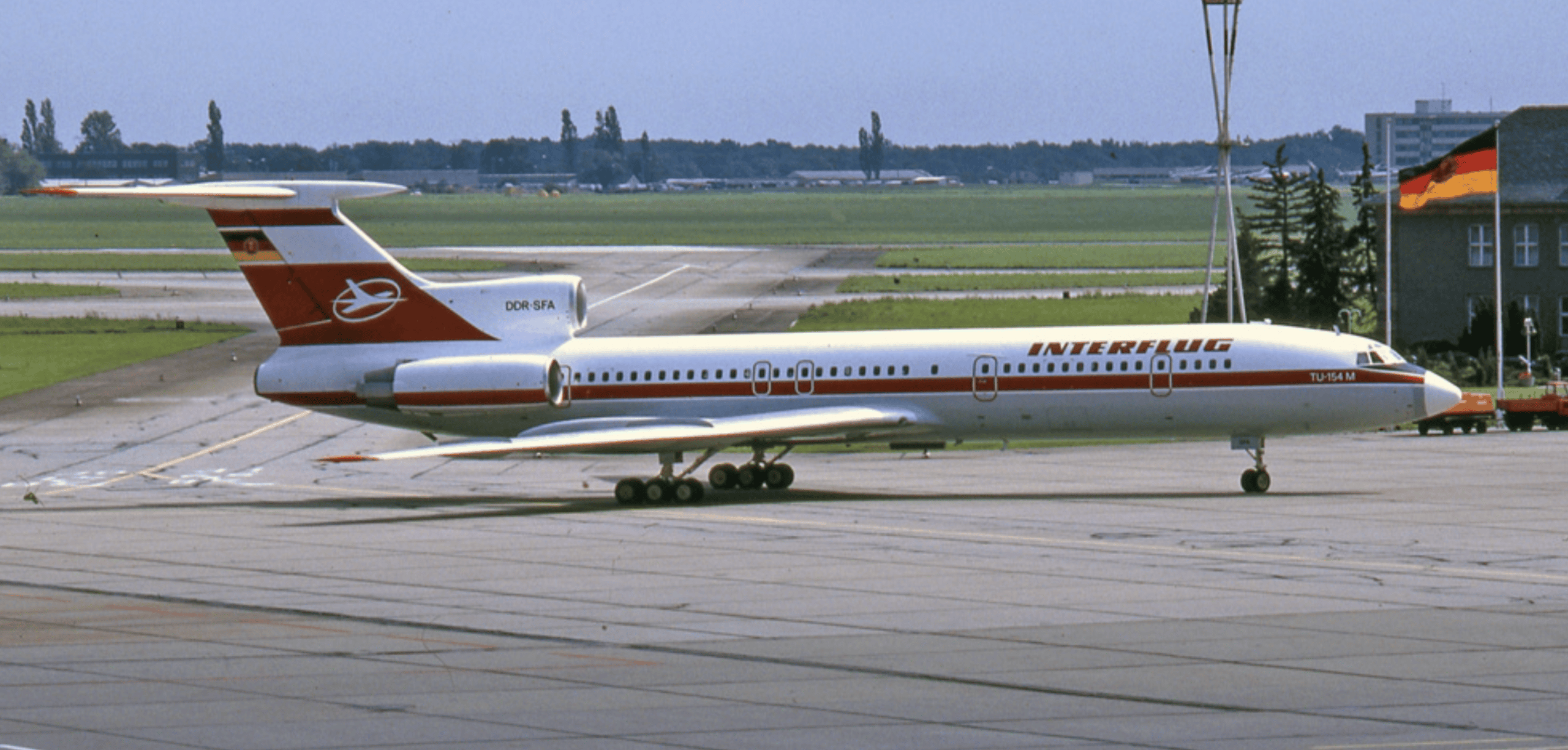
A Tu-154M of TG-44 in Schönefeld in the secure area
THE SHADOW FLEET: THE ROLE OF THE MFS
Because TG-44 carried the GDR’s top political elite, it operated under intense surveillance and counter-intelligence control by the Ministry for State Security (the Stasi). Operating primarily through Department I (NVA surveillance) and Main Department VIII (transit security), the Stasi implemented deep, structural oversight:
- Absolute Personnel Screening: Every pilot, flight engineer, flight attendant, and ground mechanic underwent months of rigorous vetting. Anyone with relatives in West Germany or suspected political deviation was immediately barred.
- Infiltration by Informants: The Stasi maintained a dense network of Inoffizielle Mitarbeiter (IMs / Unofficial Collaborators) within the unit. Flight crews spied on each other, monitoring for any hint of a planned escape to the West.
- The “Two-Key” Security System: While the military maintained the aircraft, the Stasi frequently controlled the physical security of the Marxwalde hangars. No aircraft could take off without joint clearance from military command and Stasi security officers.
- On-Board Security Agents: On high-profile flights, armed Stasi agents from the Hauptabteilung Personenschutz (Personal Protection Division) flew undercover as cabin crew to protect leadership and prevent the flight crew from hijacking their own aircraft to defect.
FOREIGN STOPOVERS: HIGH-STAKES WESTERN SECURITY
When TG-44 aircraft crossed the Iron Curtain into Western or non-aligned airspace, Stasi anxiety reached its peak. A single defection using a state aircraft would cause catastrophic international embarrassment. To mitigate this risk, strict security protocols were enforced on Western soil:
- The Locked Cockpit Rule: Once landed at a Western airport, the flight deck was never left unattended. At least one Stasi security officer or a highly trusted crew member remained inside the cockpit at all times to guard the flight controls.
- Consular Isolation and “Group Movement”: Crew members were strictly forbidden from moving freely or leaving the airport tarmac alone. While off-duty, they were immediately bussed to secure locations—usually the local GDR Embassy—under the watchful eye of an onboard Stasi supervisor.
- Ground Refueling Restrictions: To prevent Western intelligence services from bugging the aircraft or staging technical tampering, a TG-44 officer closely monitored all foreign ground handlers. Technicians from the host airport were rarely allowed inside the cabin without an escort.
- Sanitized Communications: Flight crews were strictly prohibited from making personal phone calls, buying Western newspapers, or interacting with airport personnel beyond mandatory air traffic control communication.
OPERATIONAL HISTORY: PROTOCOLS PUT TO THE TEST
Honecker’s Historic 1987 Visit to West Germany
The peak of TG-44’s security operations occurred during Erich Honecker’s official state visit to the Federal Republic of Germany (FRG) in September 1987. Flying an Il-62M in Interflug colors into Cologne-Bonn Airport, the Stasi feared Western intelligence entrapment. Armed agents completely sealed off the aircraft on the tarmac, keeping the crew under 24-hour surveillance inside isolated transit quarters.
Transatlantic Flights to Cuba and the Submarine Threat
Long-range diplomatic missions to Havana pushed the Il-62M fleet to its limits. Flying through international corridors heavily monitored by NATO, the primary fear was a forced emergency landing in a hostile territory. Flight routes were kept entirely secret from the flight crew until the absolute last moment before takeoff to ensure the pilots could not deliberately divert toward a US airbase.
The African Diplomatic Tours
During the late 1970s and 1980s, GDR leadership frequently toured non-aligned African nations (such as Angola, Mozambique, and Ethiopia). Navigating immense distances with sparse regional radar coverage, TG-44 flew out its own advance teams of Stasi technicians days prior. They effectively seized control of local airport hangars and manually tested aviation fuel for tampering before it was ever pumped into the state aircraft.
The 1989 UN General Assembly Flights
In the final, tense months before the fall of the Berlin Wall, East German delegations traveled to the United Nations Headquarters in New York City using the newly delivered Tu-154M aircraft. With East Germany rapidly destabilizing, the temptation to seek asylum was high. The Stasi implemented a strict “hostage” personnel policy, heavily favoring crew members whose young children and spouses remained behind in the GDR.
POST-1990 LEGACY
Following the historic reunification of Germany on October 3, 1990, TG-44 was formally disbanded. However, the unit’s pristine maintenance records and highly capable aircraft caught the attention of the unified German Luftwaffe.
Instead of being scrapped, several flagship TG-44 aircraft—including the advanced Tu-154Ms and long-range Il-62Ms—were absorbed into the West German federal fleet, continuing to serve the unified German government and participating in international Open Skies observation missions throughout the 1990s.
Authors note:
“Whilst working in Berlin in the 1980s I had a professional interest in the DDR and part of my remit was to gain intelligence on TG-44. Western intelligence was aware of TG-44 and it’s operations.
I was involved in attempting to recruit an “asset ” at Marxwalde. I believe we were successful and we received a lot of quality intel.
I was informed years later that after reunification our asset was in fact controlled by the MfS, interesting times indeed.”